Thiamin (vitamin B1): what it does & best food sources
What it does — EU-authorised health claims
Thiamine contributes to normal energy-yielding metabolism.
Thiamine contributes to normal psychological function.
Thiamine contributes to the normal function of the heart.
Wording as authorised in Regulation (EU) No 432/2012 EUR-LexEU Commission
How much do adults need?
| Age | Men | Women |
|---|---|---|
| 19–30 | 1.2 mg | 1.1 mg |
| 31–50 | 1.2 mg | 1.1 mg |
| 51–70 | 1.2 mg | 1.1 mg |
| 71+ | 1.2 mg | 1.1 mg |
- US Recommended Dietary Allowance / Adequate Intake (US National Academies), as published by NIH ODS — see the table above. NIH ODS
- US label FDA Daily Value: 1.2 mg. On a US food label, 5 % DV or less per serving is low and 20 % or more is high. FDA
- EU label EU Nutrient Reference Value: 1.1 mg. EUR-Lex
Best food sources (per portion)
| Food | Portion | Thiamin (vitamin B1) | % US DV | % EU NRV |
|---|---|---|---|---|
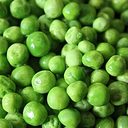 Green peas, frozen | 100 g | 0.6 mg | 50 % | 55 % |
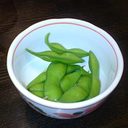 Edamame (immature soya beans) | 100 g | 0.43 mg | 36 % | 40 % |
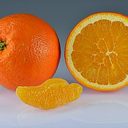 Orange | 150 g | 0.33 mg | 28 % | 30 % |
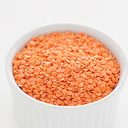 Red lentils (dry) | 60 g | 0.31 mg | 26 % | 28 % |
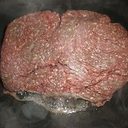 Beef mince, lean | 125 g | 0.29 mg | 24 % | 26 % |
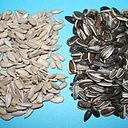 Sunflower seeds | 15 g | 0.28 mg | 24 % | 26 % |
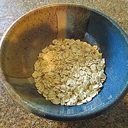 Oat flakes (rolled oats) | 50 g | 0.28 mg | 23 % | 26 % |
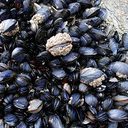 Mussels | 150 g | 0.24 mg | 20 % | 22 % |
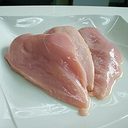 Chicken breast, skinless | 150 g | 0.23 mg | 19 % | 20 % |
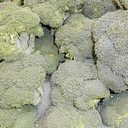 Broccoli | 150 g | 0.23 mg | 19 % | 20 % |
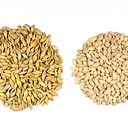 Wheat germ | 10 g | 0.22 mg | 18 % | 20 % |
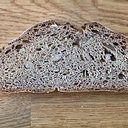 Wholemeal rye bread | 80 g | 0.21 mg | 18 % | 19 % |
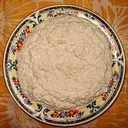 Tahini (sesame paste) | 15 g | 0.21 mg | 18 % | 19 % |
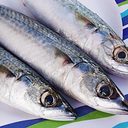 Mackerel | 125 g | 0.21 mg | 18 % | 19 % |
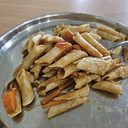 Wholemeal pasta, boiled | 180 g | 0.18 mg | 15 % | 16 % |
Per normal portion. Values from BLS 4.0. % US DV = share of the FDA Daily Value. % EU NRV = share of the EU Nutrient Reference Value.
Sources
- Thiamin — fact sheet for health professionals — NIH Office of Dietary Supplements
- Daily Value on the Nutrition and Supplement Facts labels — US Food and Drug Administration
- Regulation (EU) No 1169/2011 on food information (Annex XIII: Nutrient Reference Values; Art. 7(3)) — European Union (EUR-Lex)
- Commission Regulation (EU) No 432/2012 — list of permitted health claims (consolidated) — European Union (EUR-Lex)
- EU Register of nutrition and health claims made on foods — European Commission
- Bundeslebensmittelschlüssel (BLS) 4.0 — German Nutrient Database — Max Rubner-Institut